Bazaar-e Vakil: (Vakil Bazaar)
(Vakil Bazaar; 08:00-dusk) located near the Vakil Mosque, Vakil Bazaar was a part of Karim Khan Zand Plan to make Shiraz into a great trading center. It has five entrances and two rows of shops. The wide vaulted brick avenues and wide corridors, high ceilings along with openings which allow air circulation and penetration of light beautifully demonstrate Zand dynasty's architecture.
Seray-e Moshir:
One of the best places to do souvenir shopping in Shiraz is Seray-e Moshir. It is located beside the south entrance to the Vakil Bazaar with a very pleasant environment. There are small pavilions where Persian handicrafts are displayed for sale.
Arg-e Karim Khan: (Karim Khan Citadel)
(Shohada Sq. 08:00-19:30) This structure can be easily found at a corner of Shahrda Square close to Vakil Bazaar. The construction of Arg-e Karim Khan goes back to the second half of 18th century. Its shape is like a medieval fortress. At times, the citadel was used as a prison. Today, it is a museum operated by Iran's Cultural Heritage Organization.
Arg-e karim Khan has a land area of 4,000 square meters and consists of four high walls connected by four 14 meters round brick towers at a 90-degree angles. The citadel's design combines military and residential architecture, for it was the home of Karim Khan and the military centre of the dynasty. It is one of the most important monuments of the Zand era and especially that of Karim Khan. It is also important because of depicting the architectural style of this era.
Bagh-e Nazar & Pars Museum: (Nazar Garden)
(Zand Blvd. 08:00-noon & 14:00-17:30) Nazar garden is another historic garden of Shiraz, where Zand dynasty museum (Pars) is located in its Kolah Farangi Building.
Pars museum with an octagonal stunning building and stalactite ceiling is a particular highlight in which royal guests were hosted by Karim Khan and it was also used for holding official ceremonies.
Pars museum is a display of almost 30 handwritten Qurans, a number of magnificent paintings of famous Persian artists. The tomb of Karim Khan is situated in the eastern royal chamber.
Masjed-e Vakil: (Vakil Mosque)
(Near Bazaar; 08:00-20:00) Vakil mosque is one of the most important artistic and historical buildings in Shiraz, remained from the Zand period. It is situated west of Vakil Bazaar. It was built in 1187 (AH) during Zand Dynasty and covers an area of 8,660 square meters. On the two sides of the entrance gate there are magnificent tile-works and arches that show Persian art in tile working and painting. And it has only two iwans instead of the usual four, on the northern and southern sides of a large open court.
Hammam-e Vakil: (Vakil Bath)
(Taleqani St. 07:30-17:30) Hammam is located near the Vakil Mosque where as its name shows, is a monument of the Zand period. During the time of its construction, 18th century, private baths in homes were rare and going to this bath was considered a royal treatment. It was not only famous for its uniqueness and diversity of people who would attend but also for its beautiful architecture featuring traditional Persian dome style ceilings. The turquoise colored tiles that decorate the ins and outs of the buildings are also a historically famous trend of Persian architecture. The building is used as a museum now.
Aramgah-e Shah-e Cheragh: (Shah-e Cheragh Shrine)
(Ahmadi Sq. usually 24 hours) Mausoleum of King of the Lights; Shah-e Cheraq is the largest shrine in Shiraz which is the burial place of Seyed Mir Ahmad, brother of Imam Reza (6th Imam of Shiites). Most of its architecture related to Qajar period and the Islamic republic.
The expansive courtyard is a great place to sit and lost in the magic view of blue-tiled dome and dazzling gold-topped minarets while listening to bird's singing and crowd litany. In the shrine itself, countless minute mirror tiles reflect light and sanctity.
Women should wear chador before entering to the shrine. You can borrow one from kiosk available there with US$1.0 that is a fare rate. Cameras are forbidden.
Madraseh-ye Khan: (Khan School)
(Dastqeib St. knocks on the door) In 1615, Imam Gholi Khan who was governor of Fars founded this serene theological college for about 100 students. It is one of the most famous and greatest schools in Shiraz. There are beautiful decorations and tiling in entrance of school. The doors are usually closed but if you're lucky, the caretaker will open it. If you get in, ask to be shown to the roof where a panorama view has over the bazaar.
Masjed-e Nasir-al-Molk: (Nasir-al-Molk Mosque)
(Lotf Ali Khan Blvd. 08:00-14:00 & 15:30-19:00) Down the road from Madreseh-ye Khan is Nasir-al-Molk mosque which stands out as one of the most impressive mosques in the country. It has elegant decoration particularly at its columned prayer hall where stain glass windows let the light through in the morning.
It is also known as the "Pink Mosque", the combined visuals of its stained-glass windows, carpeted floors, colorful tile work, and geometrically sublime arches and pillars are astonishing to behold.
It's always recommended to photographers to come to this beautiful mosque early in the morning to benefit lights through colorful glasses and capture nice shots.
Naranjestan & Khan-e Zinat ol-Molk: (Naranjestan Garden & Zinat ol-Molok House)
(Lotf Ali Khan Blvd 08:00-18:30) Narenjestan dates back to Qajar era. Due to abundance of sour orange trees it is called Narenjestan.
Its building has been a place where administrative purposes meeting for ordinary people and meetings among dignitaries and nobles were held. It stands two meters above the yard and is mainly made of bricks and the ceiling is covered with beautiful paintings and patterns. Outside the building you can see bas-reliefs of Achaemenid soldiers, lions, tombs, and pictures of fighting mythological creatures which have been inspired by carvings at Persepolis.
Down a small street beside the garden is the Zinat ol-Molok House with twenty rooms embellished with paintings, mirrors, stucco decoration and tile works resembling Persian rugs.
Aramgah-e Hafez: (Hafez Tomb)
(Golestan Blvd. 08:00-21:30) Hafez is the 14th century poet of Iran who was born, lived and died in Shiraz. He lived in the Ilkhanid era when Shiraz exceptionally escaped the devastation and massacre of foreign Mongol invaders. Yet, living was tough and difficult for the intellectuals who wanted to express themselves and criticize the ruling system. This led Hafez to use figurative language in his works, a feature that has added to the beauty of his poems.
The reputation of Hafez went beyond the borders of Iran and found some followers in India. Gute, the German poet was later inspired by him.
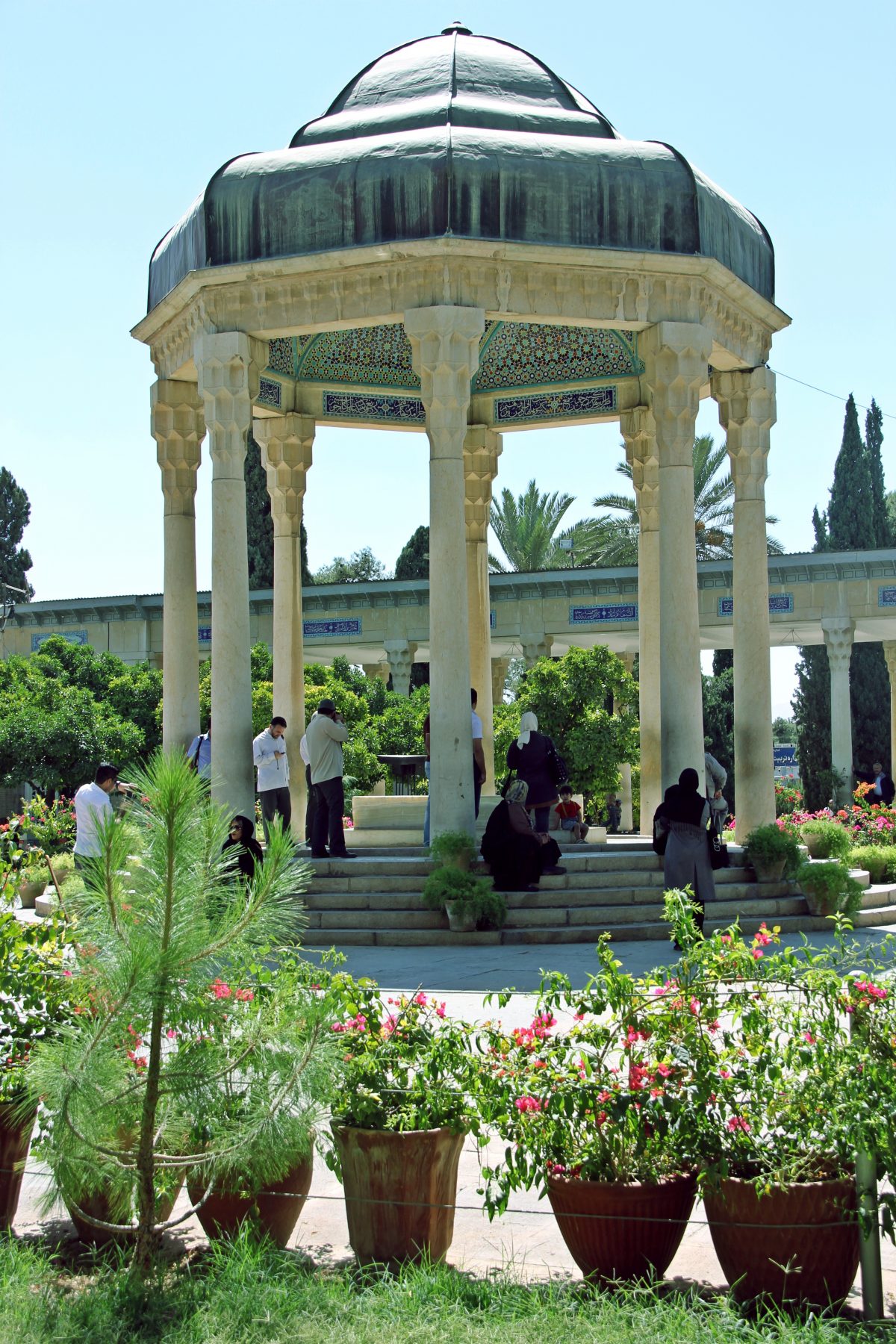
By the command of Karim Khan Zand, a mausoleum was built to honor Hafez at his burial place with eight pillars supporting a roof made of copper in 1773. The ceiling is decorated with mosaic works that shines in lively colors. This structure is located in a charming garden.
Hafez tomb is a pilgrimage place for many Iranians. Spending time by sitting in a discreet corner of the grounds at sunset or even after that; with the tomb floodlit and singings of birds or traditional music played all over the garden, you will feel magic of ancient Persia.
Aramgah-e Saadi: (Saadi Tomb)
(Bustan Blvd. 07:30-:2:30) Saadi, from the 13th century, is one of the major influential Persian poets of the medieval period who is recognized in the literary world for the quality of his writing style and in the spiritual realm for the depth of his thoughts.
And his tomb is one of the major tourist attractions of Shiraz. Every year many Iranians and even non-Iranians pay a visit to this burial place and show their respect to Saadi and interest in his works, prose and poems. Saadi is a globally known scholar whose words has touched men's heart and changes their mind into being a better human. Surrounding garden in Saadi mausoleum is a gorgeous place to spend some hours in an afternoon.
His poem written eight centuries ago became a motto and decorates the gate of the United Nations building entrance. Bani Adam, the Children of Adam, is an aphorism calling for the breaking of all barriers.
Imamzadeh-ye Ali Ebn-e hamze: (Ali Ebn-e Hamze Holly Shrine)
(Hafez St. dawn-dusk) The resting place of Emir Ali, nephew of Shah-e Cheragh boasts a majestic blue dome that overlooks the surrounding cemetery. The interior consists of high-ceilings and rather exquisite mirrored tile work, typical of Iranian shrines. Dress modestly; chadors are provided for visiting women.
Bagh-e Eram: (Eram Garden or Garden of Paradise)
(Eram Blvd. 08:00-12:30 & 15:00-17:00, 19:00 summers) It was established during the Seljuk period and is a UNESCO-listed garden. There are many citrus trees in Eram Garden, but it is especially famous for its cypress trees. While citrus are being perished during winter, evergreen tall trees stand firmly; they're cypress.
Best time for visiting Eram Garden is in springs.