Tappeh Hessar: Of the historical treasures in Damghan, one must refer to the valuable Tappeh Hessar which was constructed before the birth of Christ. Professor Hertzfeld (1931-1933) and Dr. Schmidt (1933-1938) were the first archeologists to explore the Tappeh.
Tappeh Hessar, with several layers of civilizations, conceals a long history. Part of the layers in the Tappeh belongs to the Medes dynasty whose civilization coincided with Mesopotamia. Another layer covers the Achaemenid, Parthian and Seleucid periods. Tappeh Hessar reached its height of glory during the Seleucid and Parthian periods. During the reign of Tirdates 1 (Arcase II), Damghan was the capital of the Parthian empire in Iran. With the discovery of relics from that era, one comes across another layer which is ascribed to the Sassanid dynasty.
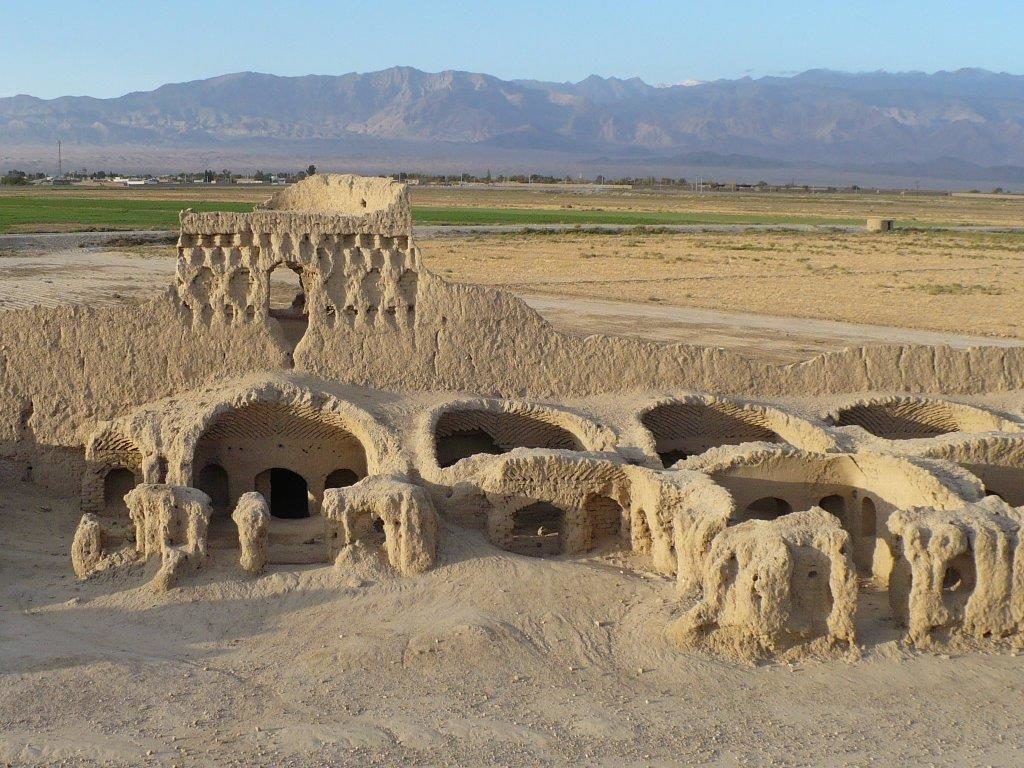
Tappeh Hessar, Damghan
Tarikhaneh Mosque: Tarikhaneh Mosque is in fact the oldest mosque in Iran belonging to the 1st century after arrival of Islam which still preserves its original shape. Tarikhaneh and Nayeen Mosque in Isfahan are the only mosques in the Islamic World which resemble the Medina Mosque. This mosque was built during the 8th century A.D. by imitating Roman, Iranian and Arabic architecture. This is an Arabic design but the building material and architecture is Sassanid. This leads us to believe that originally it had been a fire temple during the Sassanid period, and later the mosque was built over its ruins. One column resembling Sassanian architecture at the eastern wing is a proof of this assertion.
Tarikhaneh Mosque is equipped with a square yard and a gallery with 18 columns facing the Qebleh and the three sides of the yard are surrounded by porticos. The minaret rising over the mosque is said to belong to Seljuks and the tiled inscription over the minaret is in fact the oldest tile work in Islamic architecture.
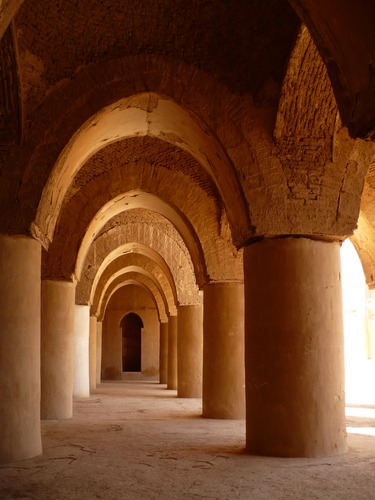
Tarikhaneh Mosque, Damghan
Fortifications: Walls or fortifications and battlements have survived in many parts of Damghan. As mentioned in its history, the wall was very wide and enabled chariots to pass over it. The remains of that wall can be seen in the north and south of Damghan.
Seljuk architecture: Much treasure has survived from the Seljuk period in Damghan. Peer-e Alamdar's Shrine (The Old Staff Bearer's Tomb), Jame' Mosque, the minaret of Jame' Mosque, Tarikhaneh Mosque, Mansourkouh, Imamzadeh Jafar Tower and Chehel Dokhtaran Vault are buildings in which Islamic architecture from Seljuk period onward is seen.
Chehel Dokhtaran Vault: Chehel Dokhtaran Vault is located at the center of Damqan and behind Imamzade Jafar, both of which belong to Seljuk period. A Kufi inscription in the edifice says the vault was built in 466 A.H. (1087 A.D.) and has survived without cracks although the city is lying on the earthquake belt.
What is more interesting about the vault is its onion-like dome adorned by bricks with artistic images and an inscription. The building, which used to be a family vault, is 14.8 meters high.
Cheshmeh Ali (spring): Cheshmeh Ali is one of the permanent springs in Damghan, 30 km north of the city. Thanks to its verdant foliage and pleasant climate, this region has been frequented by people from ancient times. During Qajar era, many buildings were constructed in the precincts of Cheshmeh Ali among which Fathali Shah and Agha Mohammad Khan palaces still exist. Fathali Shah's palace was built in the middle of a lagoon placed between the first and second springs and Aqa Mohammad Khan's palace is facing opposite the former palace. Cheshmeh Ali attracts many tourists.
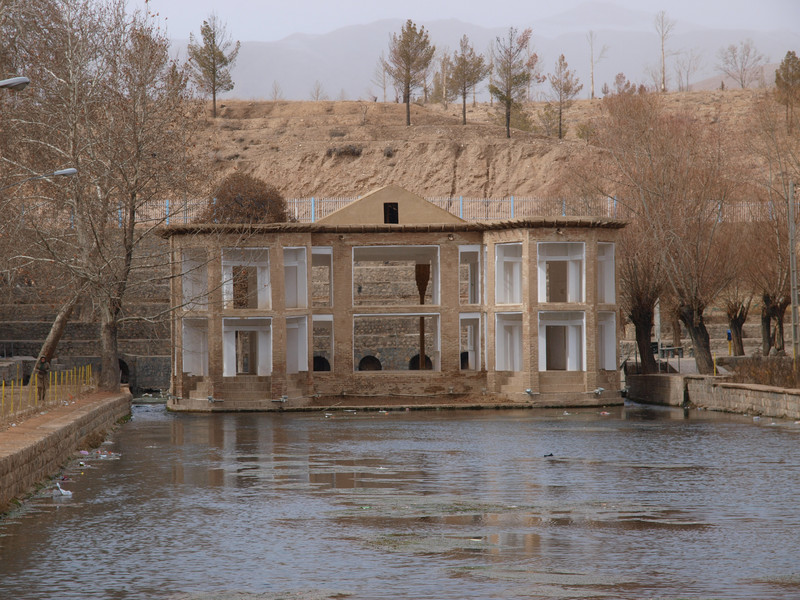
Cheshmeh Ali, Damghan