Grand Bazaar: (15 Khordad Ave. 07:00-17:00 Sat-Wed & 07:00-noonThu) Tehran Grand Bazaar is not only the city’s biggest, but it’s also the largest bazaar in the world! Although there is evidence traders have been on this site for nearly 1,000 years, what we see today is just under 200 years. It is located in the south part of Tehran, near many important attractions, including the Golestan Palace.
The bazaar always played an important role not only in the city’s economy but also many important decisions that changed Iranian history were made here. That’s because many of the bazaris (the owners of shops and stalls) are very wealthy and have a lot of political influence. They represent the religious and politically conservative part of society.
The Grand Bazaar is a true giant local market, where locals trade gold, paper, food, copper, clothing etc.... The nearly endless maze that forms the bazaar is the perfect place to get lost. Here the more you walk around, the more you realize that you have to walk. There so much helpful people who know English and are eagerly ready to help you. Or even invite you to a tea.
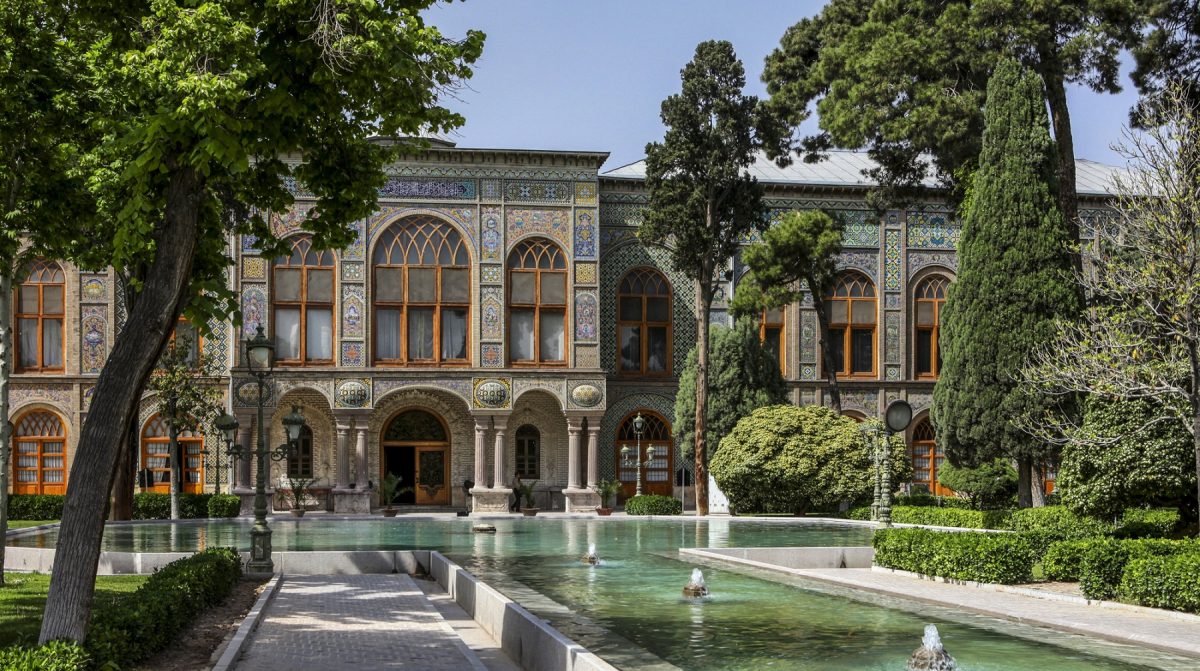
Golestan Palace: (15 Khordad Ave. 09:00-16:00) Golestan Palace is the former royal Qajar complex in Tehran. The Palace is remains of Tehran's Historical Citadel, built at the time of Shah Tahmasb I in Safavid period. It was reconstructed at the time of Karim Khan Zand and was chosen as the venue of the royal court and residence at the time of Qajar Kings.
The Royal Court and Residence occupied more than one third of citadel. Like traditional Iranian houses, it had two interior and exterior quarters. The exterior quarters consisted of the administrative section of the royal court and a square shaped garden known as Golestan or rose garden. These two parts were separated by several buildings that were destroyed in Pahlavi period.
In its present state, Golestan Palace is the result of roughly 400 years construction and renovations. The buildings at the contemporary location each have a unique history.
National Museum of Iran: (30 Tir St. 09:00-15:00, Tue-Sun) National Museum of Iran is one of the best place to visit Iran's rich history; where contains about 300,000 museum objects in an area more than 20,000 square meters. Designed by French architect Andrew Godard and completed in 1928, it is one of the more attractive modern buildings in Tehran.
It is not only the largest museum of History and Archaeology of Iran, but ranks as one of the few most impressive museums of the world in regard to great volume, diversity and quality of its huge monuments.
National Museum of Iran tries to preserve relics of the past to hand down to the next generations, raise better understanding among world nations, discovering and showing Iranian’s roles in shaping world culture and civilization and trying to enhance public knowledge.
National Jewels Museum: (Ferdosi St. 14:00-16:00 Sat-Tue) The National Jewelry Treasury is housed within the Central Bank of the Islamic Republic of Iran and accessed through its front doors. Most of the collections date back to Safavid times.
Kuh-e Nur is world's largest cut diamond found its way into the sticky fingers of the colonial British and has been locked up in the Tower of London.
National Jewels Museum is the most dazzling collection of gemstones and jewelry known in the world. Darye-ye Nur (Sea of Lights) a pink diamond weighing 182 carats and said to be the largest uncut diamond in the world; is available here.
Glass & Ceramic Museum: (30 Tir St. 09:0016:30 Tue-Sun, to 18:00 summer) The beautiful building of the Museum of Glassware & Ceramic is the mansion housing glass wares and ceramics that was originally ordered to be built as the personal residence of a politician named Ahmad Qavam in early 1920s.
The objects present in this museum, which is also called Abgineh, belong to pre-Islam period up to the contemporary Iran.
Tehran Museum of Contemporary Art: (Kargar Ave. 10:00-17:30 Sat-Thu) It is located on the western side of Park-e Laleh. The building was constructed during the shah’s rush to build modern landmarks in the 1970s.
The museum boasts works by Picasso, Matisse, Van Gogh, Miró, Dalí, Bacon, Pollock, Monet, Munch, Moore and Warhol, among many others.
On the open market, the collection is estimated to be worth between US$2 billion and US$5 billion.
Carpet Museum of Iran: (Northwest corner Of Laleh Park, Fatemi and Karegar junction, 09:00-17:00 Tue-Sun) It was open in 1977 with about 135 master pieces of Iranian carpets. Iran carpet museum composed of two exhibition galleries covering an area of 3400 meters. The ground floor gallery is assigned for permanent exhibitions and the upper floor gallery is considered for the temporary exhibitions of carpets, kilims, and carpet designs. The variety of carpets with intricate, genuine, beautiful and traditional designs and fine colors from the Safavid period to the present time are put on display in the Museum.
These masterpieces of carpet weaving industry of Iran manifest creativity and delicate nature of the Iranian artisans and craftsmen and are the product of the most outstanding designers, masters and weavers from different part of Iran. Its library is enriched with 3500 books. The collection of carpet museum comprises of samples of Iranian carpets from the 9th century up to now.
Sa'd Abad Complex: (Vali Asr Ave. Taheri St. 09:00-16:00) With an area of more than 110 hectares, there lays Sa’ad Abad complex at the foot of the Alborz ranges, north of Tehran. It was first the summer residence of Qajar kings, and then turned into Reza Shah’s summer residence following expansion and annexation of some other quarters.
The complex was first inhabited by Qajar monarchs and royal family in the 19th century. After an expansion of the compounds, Reza Shah lived there in the 1920s. And his son, Mohammad Reza Pahlavi moved there in the 1970s. After the Iranian Revolution, the complex became a museum. Here are some of the opening museums and galleries:
- White Palace (Palace of the Nation): This palace was built in surrounding area of 2164 square meters; it is a two story building and a basement with a total of 5000 square meters area. White Palace is the largest mansion in this collection. In addition to ceremonial and official affairs, it was served as the Pahlavi summer residence. This building includes 54 units including ten large ceremonial saloons which was the official reception of Mohammad Reza Shah.
- Green Palace: it was built at the end of Qajar era and extensively remodeled by Pahlavis. The name is given from the color of its facade. The palace is museum of Persian art like mirror parquetry, carpets, illumination and plaster work.
- Royal Automobile Museum: The most interesting of the remaining museums include Royal Automobile Museum, with the Rolls Royce, Cadillac and a unique armored Mercedes Benz 600.
- Museum of Fine Arts: There are paintings by modern and older Iranian artists, plus Western painters including Salvador Dali.
Niavaran Palace: (Niavaran Ave. 08:00-16:30 winter, 09:00-17:30 summer) Niavaran Palace Complex is in 9000 square meters area. It consists of several buildings and a museum. The main Niavaran Palace, completed in 1968, was the primary residence of the last Shah, Mohammad Reza Pahlavi and the Imperial family until the Iranian Revolution. The Sahebqaraniyeh Palace from the time of Qajar dynasty is also inside this complex.